
Imagine a tiny figure crouching beneath a tree and thick brush, trying to ward off the cold of the fast-approaching night. Hundreds of people — rescue workers, family, neighbors — are looking for the boy, a walk away from a backyard swing set that followed his curiosity into the woods.
Overhead, a small, unmanned aircraft — tinier than the tot who’s the subject of this search-and-rescue operation — buzzes like a swarm of bees and hovers. A couple of miles away, the drone pilot thought he saw a shadow move on his remote controller screen. He lowers the drone for a better look, maintaining position above that shadow.
And then the pilot knows: the shadow moves again. It’s a boy! The operator checks the GPS coordinates and radios the teams scouring the countryside. Then, the nearest rescuers change direction. Within minutes, they should reach the missing boy, bringing blankets, food, and hugs.
A hypothetical situation? Yes, but it’s one out of many that play out frequently in communities worldwide. There’s no question that public safety teams are turning to drones to do things people can’t accomplish alone.
However, not just any drone can do the critical work of search and rescue missions. Therefore, here’s what to look for in a rescue drone and the best drones to help you save lives.
Key Capabilities of Search and Rescue Drones
A good rescue drone is like a superhero, minus the cape. In addition to flying, it can see better than an ordinary human and brings extra power to any mission.
Whether looking for a missing child, lost hikers, or victims buried in a disaster, a search-and-rescue drone must have some key features to get the job done effectively.
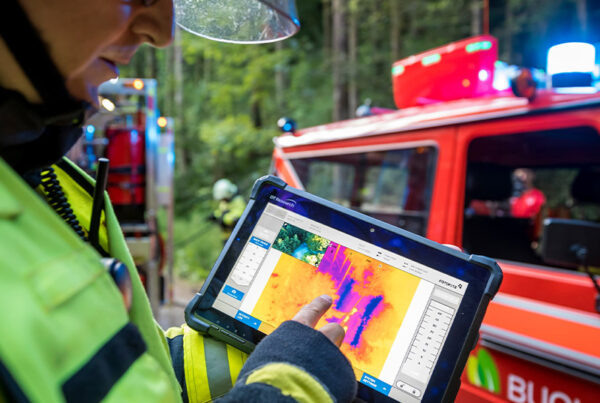
Cameras: A camera is a pilot’s eye in the sky. A rescue drone should have a good thermal imaging camera, which can see heat sources in different colors or shades on the remote controller screen, and a conventional red-green-blue camera for video and stills. The thermal sensor can identify heat sources, including a human body, through such impediments as debris, snow, foliage, smoke, and fog. The RGB camera should have zoom capabilities, enabling the pilot to get a closer look with the touch of a button.
Batteries: The availability of spare batteries is a must, as is a charging hub that can replenish multiple batteries simultaneously.
Extended flight time: Search and rescue missions are best carried out with drones that can stay aloft for an extended period of time. This is crucial when finding people in challenging areas such as those impacted by weather, smoke, or vegetative growth.
Flight: Rescue operations require not just flying, but also hovering in many cases. A pilot hovers when the cameras pick up something that bears further examination.
Range: Rescue operations are likely to involve vast areas. That makes extended-range — 3 miles or more, but as far as 9 miles in some cases — ideal in drones for search.
Clear image transmission: The drone pilot can see what the aircraft sees if images are transmitted clearly over the long distances between the operator and aircraft. The images beamed to the pilot need to be sharp, reliable, free of interference and displayed on a bright, sharp monitor with adequate resolution, preferably true high definition. The best setup for needing images is multiple frequencies with automatic frequency switching when interference is sensed.
GPS location: A GPS-equipped drone can recognize and communicate its location. It can return to the exact spot that it was in before leaving an area.
Obstacle sensing: When you’re flying search-and-rescue missions, obstacles can appear unexpectedly: taller treetops, terrain variations, buildings, poles, power lines, among others. Obstacle sensing alerts the pilot to avoid crashing or triggers automatic obstacle avoidance in the drone.
Image stabilization: Video may be susceptible to distortion from drone movement. Video can be stabilized electronically while or after it is shot, or for better results, mechanically, with a gimbal that cancels out movement on three axes: yaw, pitch, and roll.
Safety boost with Automatic Dependent Surveillance-Broadcast (ADS-B): Manned aircraft automatically and continuously broadcast signals, so other aircraft know where they are. While not mandatory in a rescue drone, ADS-B is a significant safety boost, especially when an active search and rescue involves multiple drones, airplanes, and helicopters and when weather or other conditions limit visibility.
Best Search and Rescue Drones
Here are unmanned aircraft that Drone Nerds experts have evaluated as excellent search-and-rescue drones:
DJI Mavic 2 Enterprise Dual
This compact, lightweight, folding drone is small enough to be stored in any patrol car’s glove box or console. It’s operational rescue right out of the box. “Dual” means dual cameras: an RGB camera with sharp video and stills, and a FLIR MSX thermal imaging camera to spot heat sources through smoke, fog, dense foliage, and darkness. The Mavic 2 Enterprise Dual sends thermal images in high-resolution and can shoot 12MP stills and 4K video. The OcuSync 2.0 transmission transmits crystal clear 1080p images over 5 miles. Flight time is up to 30 minutes.
Mavic 2 Enterprise Dual includes Mavic Accessories:
- Spotlight, which can illuminate areas or people in night searches.
- Speaker, through which the pilot can play pre-recorded messages, such as “stay where you are, help is on the way” to a found person.
- Beacon, visible for up to three miles as it marks a location while the drone hovers.
DJI Mavic 2 Enterprise Advanced
The Mavic 2 Enterprise Advanced also has a dual camera. The thermal camera on the Advanced has a 16x digital zoom. The RGB cameras can digitally zoom 32x. The RGB camera can record highly detailed 48MP stills — four times the resolution of those from Enterprise Dual.
Positioning is super accurate because the Advanced includes an RTK module plugging into the accessories mount. RTK delivers centimeter accuracy. The spotlight, beacon, or speaker can be attached when the RTK module is not used.
The remote controller has a built-in 5.5-inch monitor that remains clear even in bright sunlight.
Autel Evo II Dual
The lightweight, compact, and powerful Evo II Dual has the right stuff as a search-and-rescue drone. Its dual cameras are extremely capable: a high-def FLIR Boson and an ultra-high-definition RGB camera capable of 8K video and 1-8x zoom, with 4x lossless. Stills are captured at an extremely rare 48MP.
Flight time is stellar at up to 40 minutes. Evo II Dual has a standard extended range of 5.5 miles. Images remain very clear, transmitted at either 720p or full high definition 1080p. The controller has a built-in 3.26-inch OLED monitor, which means video can be previewed or reviewed without a cell phone.
The Autel is U.S.-manufactured from both domestic and foreign components.
DJI Matrice Series
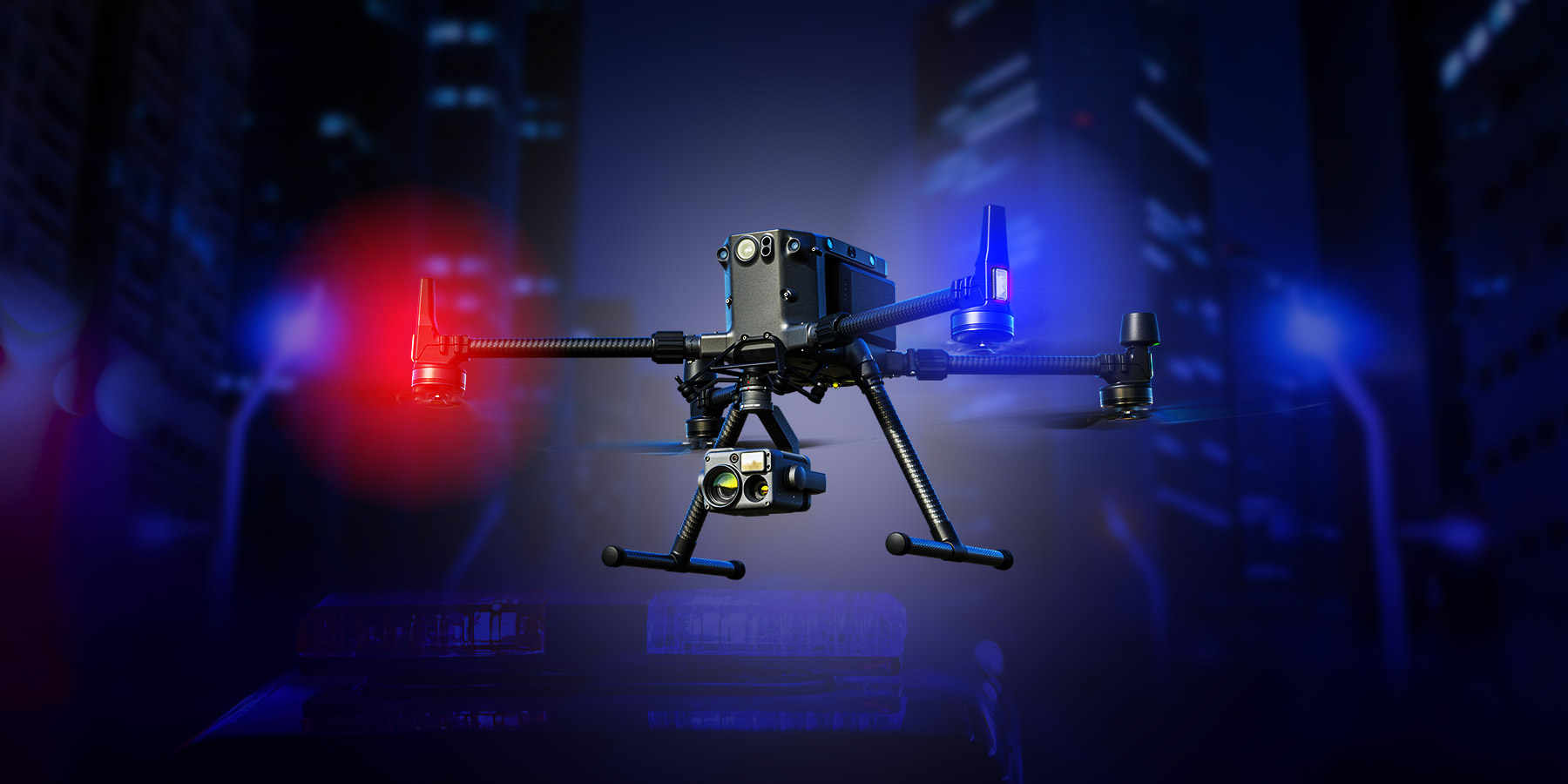
The powerful, stable Matrice 300 is an ideal rescue drone, combined with the advanced Zenmuse H20T dual-function camera. It accepts several other advanced payloads and can mount three at once.
The H20T records thermal and RGB images simultaneously. A pilot who sees something of interest during a mission can closely examine it from the air in thermal or visual views using the zoom feature. Thermal images are 640 pixels, considered high definition in infrared, and can be pulled closer with 8x zoom. The visual camera has a wide view, so the pilot can take in a larger area — critical in search and rescue — but it includes a 23x digital zoom. A precise laser range finder that works as far away from an object as 3,900 feet provides more accurate information during search and rescue missions.
Flight time is outstanding at up to 55 minutes. The extended range is more than 9 miles. Cold-weather ability is as low as -4° F. Two people can work the drone — a pilot and a camera operator, each concentrating on their duties. Sensing and positioning sensors work in all six directions.
DJI Inspire Series
Medium-sized quadcopters in the Inspire series can be purchased without a camera or controller, giving you the option of equipping it as you see fit. It can be mounted with a thermal infrared camera or with an RGB visual camera, but not both at the same time. You can also choose a controller with a superior monitor to see detail in transmitted images better, and it has a flight time of up to 27 minutes.
The Inspire series might be a better tool for police than purely search-and-rescue teams. For example, Inspire series drones can be outfitted with high-performance still and video cameras with interchangeable lenses, ideal for collecting evidence at crime scenes and conducting surveillance.
How Drone Nerds Can Help
Do you have questions or need help deciding which is the best search-and-rescue drone for you? Contact Drone Nerds’ experts to assist you in crafting the most effective drone solution tailored to your specific needs.