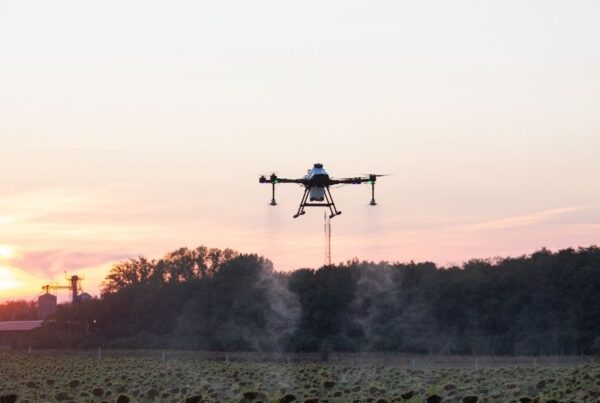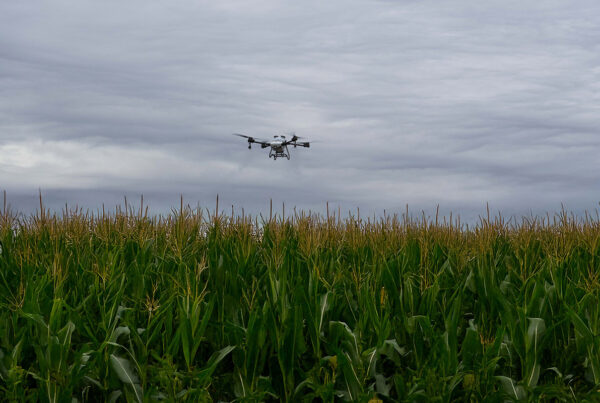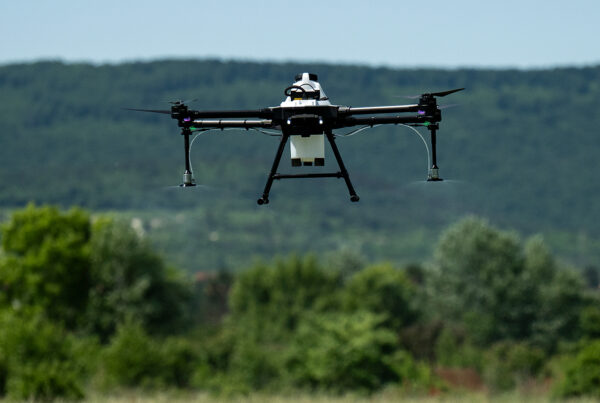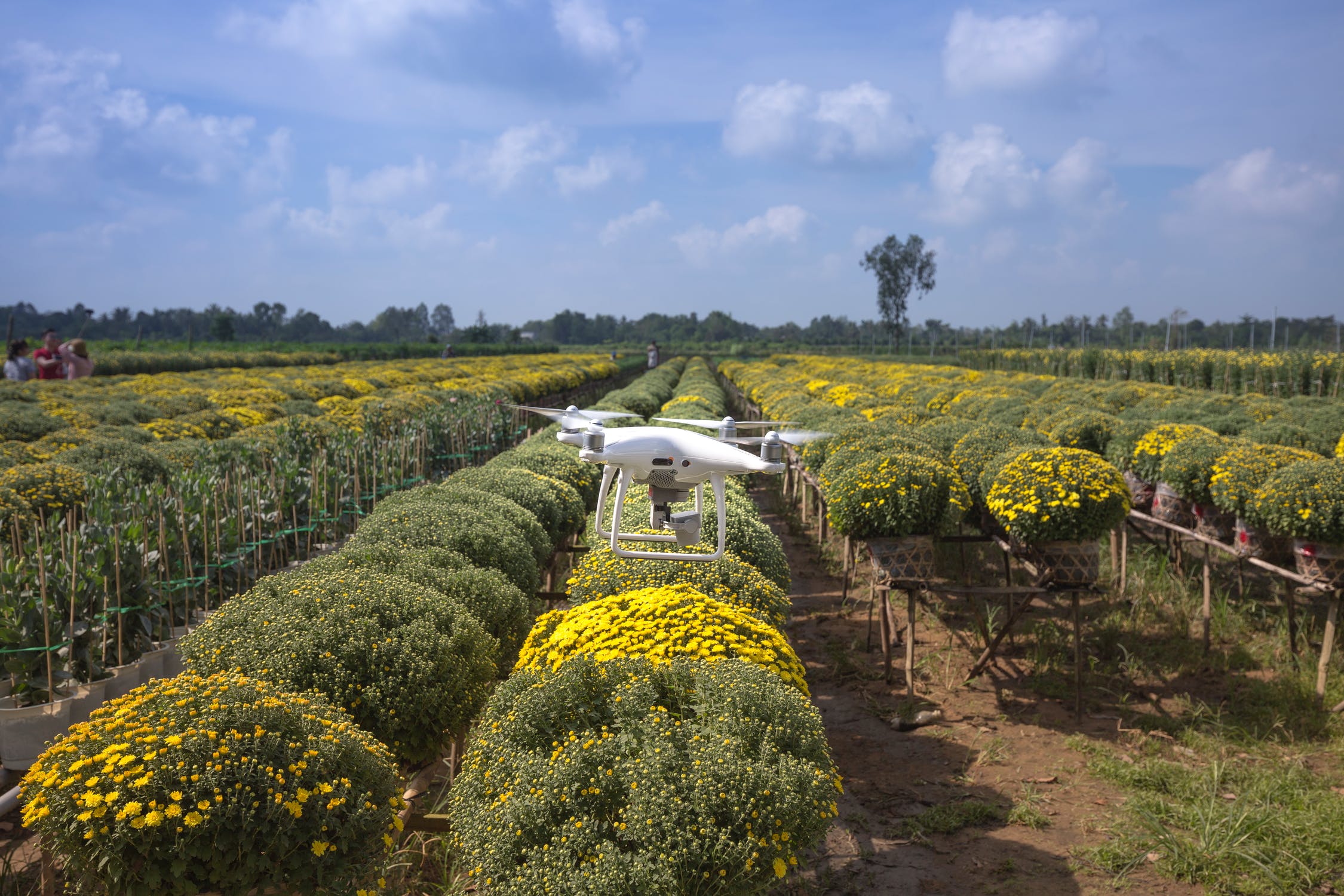
Drone technology supports sustainable farming worldwide by modernizing agricultural processes.

Food security has decreased significantly in the past three years. Impacted by unsustainable practices, Covid-related supply chain issues, rising costs of farm labor, and the limitations of agricultural processes, food scarcity is a growing concern globally.
Millions of people are affected by lack of supply and increasing prices; this has left world leaders, scientists, and agribusiness leaders scrambling to find technology-backed solutions to the crisis. Among these solutions, drone technology shows the most promise, as drones can provide cost-effective methods for crop monitoring, irrigation, seed spreading, and more.
Drones aid transparency in sustainable farming practices.
Consumer concerns for sustainability have led agribusiness leaders to become socially conscious, with many seeking to shift their operations to environmentally sustainable practices. This implies leading their operations with transparency and optimizing efficiency to preserve natural resources. These actions seek to minimize environmental impact, and give consumers a complete view of their processes, from field to fork.
Harnessing the data needed to provide completely transparent overviews of agricultural practices is a challenge that hasn’t been easy to overcome, as it involves monitoring operations across vast plots of land and tracking various factors throughout harvesting cycles. The costs associated with the labor and management of sustainable practices skyrocket food prices, making sustainable produce inaccessible to people with limited economic capacity.
Agricultural UAVs, however, lower farming costs throughout the production process. Through drone technology, farmers can capitalize on high-tech systems to modernize their workflows, like leveraging LiDAR to produce 3D maps to complete soil and field analysis at the start of the crop cycle. Farmers use the 3D maps to identify optimal irrigation flows and seed planting patterns, increasing the chances of a successful harvest. Additionally, farmers can utilize drone fleets to disperse seed pods complete with nutrients into the soil, decreasing planting costs by 85 percent.
These savings during production are passed along to consumers, making healthy, eco-friendly produce accessible.
Boosting eco-friendly efforts by leveraging drone technology in precision agriculture
To keep up with high demand, farmers and agriculture organizations must enhance crop management efforts to guarantee a plentiful harvest— to do so, they must defend their crops from pests, changes in soil conditions, and unpredictable temperature variations.
By implementing drone technology equipped with spraying capabilities, such as the DJI Agras MG-1S and MG-1P, farmers can benefit from easy farmland management. These drones feature sensors comprised of LiDAR technology, ultrasonic echoing, lasers, and other features that help drones adjust their flight speed and altitude.
Many agricultural spraying drones are equipped with thermal, hyperspectral, or multispectral sensor payloads. These sensors can calculate the vegetation index of plants, which identifies the overall health of the crop. By determining how much heat a crop, field, or soil is emitting, farmers can adjust irrigation to the precise moisture level needed, saving water long-term.
These sensors also correct the amount of liquid fertilizer, nutrients, and pest control chemicals that are dispersed. Instead of over-drenching crops, farmers can minimize the quantity of chemicals that seep into groundwater by ensuring even coverage through precise, calculated rates.
By limiting the amount of chemicals and fertilizers used in production, farmers can support sustainability efforts easily.
Opportunity for Growth
The drone market faces tremendous growth opportunities as many farmers are eager to incorporate drone technology into their operations.
The global agriculture drones market is predicted to grow to $6,244.5 million within 2021–2028, as demand for agricultural drone technology increases worldwide.
Additionally, the US FAA (Federal Aviation Administration) is becoming supportive of drone technology; in 2016, they issued legislation 14-CFR Part-107 to expand the use of commercial drones; this legislation was a huge win for the advancement of drone technology.
With legal barriers limiting the development and adoption of drones decreasing, original equipment manufacturers (OEM) companies will be able to access the tools and materials needed to enhance research and development on enterprise drone solutions.
With the adoption of new, innovative drone technology, agribusiness leaders will be able to incorporate IoT frameworks and drone fleets to support sustainable food production through smart farming.
Because smart farming methods grant farmers greater control over their crops, less food waste occurs during production, minimizing costs and increasing harvest ratios.
With greater harvest rates at decreased prices, accessibility to nutritious, whole foods becomes a reality for more people, increasing food security.
Drone Nerds has an impressive lineup of scalable agricultural drone solutions that can help reduce pollution and increase productivity.
We carry the DJI Agras series and the DJI MG-1P, a pinnacle UAV spraying solution.
Speak to a drone expert to learn more about our agricultural drone technology here.