Commercial exterior cleaning is changing as teams look for safer, more efficient ways to maintain facades, rooftops, solar panels, and industrial structures. Instead of relying only on scaffolding, lifts, rope-access systems, or technicians working at height, pressure-washing drones allow operators to stay on the ground while the drone positions the cleaning nozzle at elevation.
In the Drone Nerds ebook, “5 Ways Commercial Cleaners Are Using Pressure-Washing Drones for Exterior Maintenance,” we break down how this workflow is being applied across real-world cleaning scenarios, including high-rise facades, rooftops, solar installations, facilities management, and industrial infrastructure.
This blog gives you a quick overview of those five use cases. For the full breakdown, download the ebook to learn more about how pressure-washing drones compare to traditional workflows and where they may fit into your exterior maintenance operation.
How Drone-based Pressure Washing Works
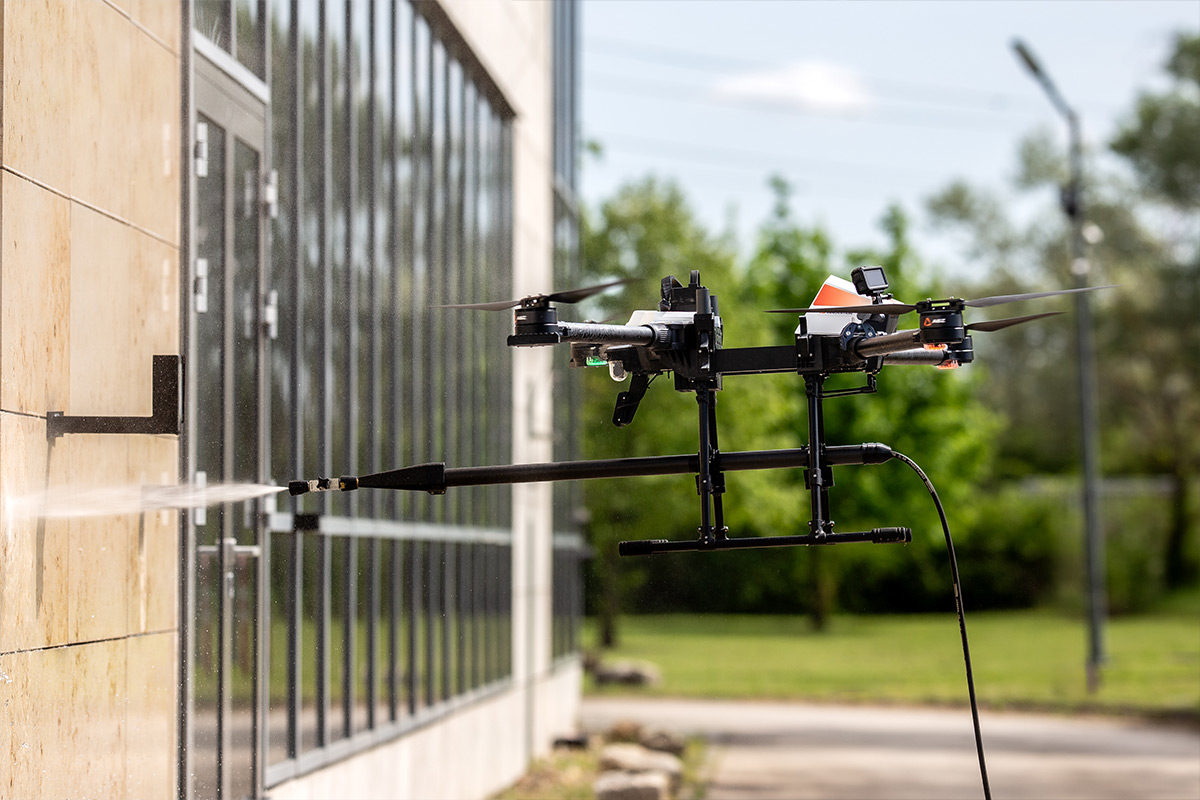
In a typical drone-based cleaning setup, the drone carries the cleaning nozzle while remaining connected to a ground-based pressure system. Water and pressure are generated at ground level. The drone then positions the cleaning output at height while the operator guides the system remotely across the surface in controlled passes.
This configuration allows teams to perform high-pressure cleaning on elevated surfaces without installing access systems around the structure. For commercial cleaners, facilities teams, and industrial operators, this can make exterior maintenance more flexible and less dependent on the positioning of heavy equipment.
1. High-Rise Facade Cleaning
High-rise facades are one of the most common environments where access defines the job. Pressure-washing drones allow operators to position the cleaning nozzle in front of glass, concrete, and commercial building exteriors while remaining safely on the ground.
For cleaning teams, this can reduce reliance on complex access setups and help streamline work across multi-story surfaces.
2. Rooftop and Elevated Surface Cleaning
Drone-based cleaning allows teams to approach rooftop surfaces from the air, reducing the need for technicians to physically walk across higher-risk areas. The ebook explores where this workflow can be especially useful and how teams are applying it in the field.
3. Solar Panel Cleaning and Elevated Installations
Solar panel installations, especially on commercial rooftops, often span large areas and can be difficult to clean consistently using traditional methods.
Pressure-washing drones can help operators move along panel arrays from a controlled ground position, supporting more efficient coverage across elevated solar installations.
4. Commercial Exterior Cleaning in Facilities Management
Facilities teams are often responsible for maintaining many different exterior surfaces across a property, including facades, walls, elevations, and rooftop areas.
With a drone-based workflow, operators can move between surfaces without repeatedly repositioning heavy access equipment. This can help facilities and cleaning teams simplify routine exterior maintenance.
5. Industrial Structure and Infrastructure Cleaning
Industrial environments often include tanks, silos, large exterior walls, and irregular structures that are difficult to reach with standard equipment.
Pressure-washing drones give teams another way to approach these complex surfaces by positioning the cleaning output directly where it is needed. The ebook provides more detail on how this applies to industrial facilities and infrastructure cleaning.
How Safety Changes with Drone-based Cleaning
In traditional exterior cleaning workflows, safety planning often focuses on personnel working at height. Crews may need to operate from lifts, platforms, rooftops, or rope-access systems.
With drone-based cleaning, the operator remains on the ground and controls the system remotely. The drone handles positioning the cleaning output across elevated surfaces, while the pressure system remains ground-based.
This does not eliminate the need for safety planning. Teams still need trained operators, proper site controls, workflow planning, and the right system for the surface being cleaned. But it does shift the safety focus from placing technicians at height to managing equipment positioning and controlled operation from the ground.
Example Solution: ABZ Innovation C10
The ebook highlights the ABZ Innovation C10 as a practical pressure-washing drone solution for exterior cleaning. It is designed to help teams apply pressure washing from the ground while using the drone to position the nozzle at height.
Key capabilities highlighted in the ebook include:
| Capability | Why it matters |
| Ground-based cleaning system | Keeps pressure generation on the ground |
| Precision distance control | Helps support consistent surface distance |
| RTK-enabled stability | Supports controlled positioning |
| Interchangeable nozzle system | Adapts to different cleaning needs |
| Designed for hard-to-reach areas | Supports facades, rooftops, solar installations, and industrial structures |
The ebook also notes flow rates of approximately 15 liters per minute, operating pressure in the range of approximately 180 to 200 bar, and a maximum height of up to 197 feet, or 60 meters.
What Commercial Cleaners Should Consider Before Adopting Pressure-Washing Drones
Pressure-washing drones can be a strong fit for exterior cleaning teams, but the right approach depends on the job site, surfaces, operating environment, and business goals.
Before adopting a drone-based cleaning workflow, teams should evaluate:
- The types of buildings or structures they clean most often
- Height, access, and surface challenges
- Required cleaning pressure and flow rate
- Operator training requirements
- Site safety procedures
- Equipment setup and transport needs
- Maintenance and support requirements
- Whether the system fits existing service offerings
The most successful deployments are not just about buying a drone. They depend on matching the right aircraft, pressure system, workflow, training, and support model to the work being performed.
How Drone Nerds Can Help
For agriculture teams, Agremo-powered analytics may need to work alongside drone hardware, payloads, training, and support. Drone Nerds helps commercial cleaning, facilities, industrial, and energy teams evaluate, configure, and deploy drone-based cleaning systems for real-world operations. Rather than treating drones as standalone equipment, Drone Nerds supports organizations with the guidance, training, configuration, and ongoing support needed to make drone adoption practical.
For teams exploring pressure-washing drones, that may include help with:
- Supporting long-term maintenance and operational readiness
- Understanding whether drone-based cleaning fits the use case
- Evaluating platforms such as the ABZ Innovation C10
- Configuring systems for exterior cleaning workflows
- Planning deployment and operator training
Frequently asked questions
What is a pressure-washing drone?
A pressure-washing drone is a drone-based cleaning system that positions a cleaning nozzle at height while water and pressure are supplied from a ground-based system. The operator controls the drone remotely, allowing cleaning teams to reach elevated surfaces without placing personnel directly on those surfaces.
What surfaces can pressure-washing drones clean?
Pressure-washing drones can be used across many exterior maintenance environments, including building facades, commercial roofs, solar panel arrays, exterior walls, tanks, silos, and industrial structures. The right fit depends on the surface, access conditions, cleaning requirements, and equipment configuration.
Are pressure-washing drones safer than traditional exterior cleaning methods?
Pressure-washing drones can reduce the need for technicians to work directly at height in certain cleaning scenarios. However, safe operation still requires trained pilots, site planning, proper procedures, and appropriate equipment selection.
Who should consider using pressure-washing drones?
Commercial cleaning companies, facilities management teams, industrial operators, energy teams, and property maintenance providers may benefit from pressure-washing drones for regular cleaning of elevated, hard-to-reach, or complex exterior surfaces.
Do pressure-washing drones replace traditional cleaning methods?
Not always. In many cases, they complement existing workflows. Some jobs may still require traditional access methods, while others may be completed more efficiently with a drone-based system.
Final thoughts
Pressure-washing drones are changing how commercial cleaners approach exterior maintenance. Across facades, rooftops, solar installations, commercial properties, and industrial structures, the workflow shifts from building access around the job to positioning the cleaning system directly where it is needed.
For teams that want to improve safety, reduce setup time, and take on more complex exterior cleaning work, drone-based cleaning is worth evaluating.
Want to see the full breakdown?
Read more in the Drone Nerds ebook, “5 Ways Commercial Cleaners Are Using Pressure-Washing Drones for Exterior Maintenance,” and learn how drone-based cleaning workflows compare across facades, rooftops, solar installations, facilities management, and industrial structures.
Download the full ebook to read more about how pressure-washing drones are being used for exterior maintenance.