When a search and rescue mission moves into the night, visibility becomes one of the biggest operational challenges.
Thermal drones support public safety teams in detecting heat signatures from people, animals, vehicles, or recently occupied areas in low-light conditions. This makes them especially useful for nighttime searches, wooded areas, open fields, shorelines, disaster zones, and large outdoor scenes where ground visibility is limited.
For nighttime or search and rescue operations, thermal drones are not a replacement for trained responders, pilots, or incident command. They are a tool that can support faster decision-making, safer search patterns, and better coordination when time and visibility are limited.
5 Ways Thermal Drones Support Low-Light Public Safety Operations
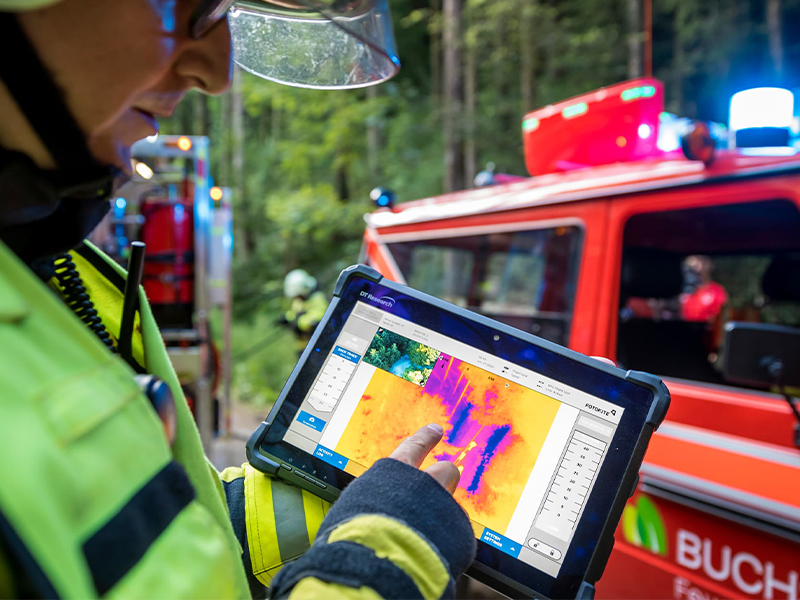
A standard visual camera depends on available light. A thermal camera works differently. It detects heat differences in the environment, which can help operators identify people or objects that stand out from cooler surroundings. In public safety operations, this supports teams in locating a missing person more efficiently, confirming areas of interest, and directing ground responders with greater confidence.
1. Locating Missing People
One of the most direct use cases for thermal drones in nighttime search and rescue is locating a missing person. This can apply to searches involving:
- Lost hikers
- Missing children or adults
- Individuals in fields, parks, or wooded areas
- Persons separated from a group after dark
- Vulnerable individuals who may not respond to calls
Thermal imaging can help operators scan areas where a flashlight, spotlight, or visual camera may not provide enough information. When a heat signature appears, the drone team can mark the location, assess the surrounding area, and coordinate with ground teams for confirmation.
The key is the workflow. A thermal drone is most effective when the agency has a clear process for search patterns, communications, map coordination, and handoff to ground responders.
2. Searching Large Areas More Efficiently
Nighttime searches often require teams to cover large areas with limited personnel. A drone can help expand visibility from above while reducing the need to send responders blindly into every section of the search area.
For example, a drone team may be able to scan:
- Open fields
- Parking lots and industrial areas
- Trails and parks
- Rural properties
- Shorelines or riverbanks
- Perimeters around last-known locations
This does not eliminate the need for ground search teams. Instead, it can help incident command prioritize where to send resources. Drone-enabled mapping can help first responders understand where potential victims may be and help guide responders more quickly to specific areas.
For agencies with lean staffing, this can be an important operational advantage. The drone provides a wider field of view while responders stay focused on the areas most likely to require immediate action.
3. Supporting Searches in Wooded or Difficult Terrain
Search and rescue missions often happen in places that are hard to navigate at night. Dense brush, uneven ground, steep slopes, water hazards, and narrow road access can slow down responders and increase risk.
Thermal drones help teams evaluate terrain before sending personnel into an area. Operators can look for heat signatures, identify possible paths, and understand whether an area should be searched by foot, vehicle, boat, or another specialized team.
In wooded areas, thermal detection can be affected by canopy density, weather, distance, and line of sight. That is why drone data should be treated as one input in the broader search process, not a standalone answer. The strongest programs train pilots and responders to understand both the value and the limitations of thermal imaging.
4. Improving Responder Safety During Nighttime Operations
Night searches can expose responders to hazards they may not see clearly from the ground. These may include unstable terrain, water edges, traffic, structural debris, aggressive animals, or unsafe approach routes.
A thermal drone can support responder safety by giving operators a broader view of the scene before teams move in. This can help teams:
- Identify potential hazards before entry
- Reduce unnecessary movement through difficult terrain
- Maintain overwatch during ground operations
- Monitor the position of responders and subjects
- Support safer route planning in low visibility
For public safety teams, the goal is not only to find the subject faster. It is also to protect the responders conducting the search.
5. Coordinating Multiple Teams During Active Incidents
Nighttime search and rescue often involves multiple responding groups, including law enforcement, fire rescue, EMS, park officials, volunteer search teams, dispatch, and incident command.
Thermal drones can help create a shared operational picture. A drone operator may identify an area of interest, communicate the location, and help guide ground teams toward the target area. Depending on the system and workflow, teams may also use mapping, live viewing, or documented imagery to support coordination.
This is especially valuable when teams are working across large areas or when ground units are approaching from different directions. A clear aerial perspective can help reduce confusion and improve communication during a time-sensitive mission.
What Should Agencies Consider Before Using Thermal Drones For Low-Light Operations?
A thermal drone program should be built around the mission, not just the aircraft. Before selecting a platform, agencies should evaluate:
| Consideration | Why it matters |
| Thermal sensor needs | The camera must support the agency’s search conditions, terrain, and identification workflow. |
| Visual camera pairing | A visual camera can help confirm context once a thermal signature is found. |
| Pilot training | Nighttime or low-light missions may require a well-trained pilot to navigate difficult airspace and support personnel who can interpret the thermal data. |
| Battery and uptime planning | Search missions may require multiple flights, charged batteries, and a plan for continuous coverage. |
| Compliance requirements | Agencies may need to evaluate FAA rules, local policies, procurement standards, and data handling requirements. |
| Maintenance and repairs | Public safety teams need systems that can remain operational when missions are time-sensitive. |
| Integration with command workflows | Drone data is most valuable when it supports incident command, mapping, and ground team coordination. |
Drone Nerds helps organizations evaluate the right drone solution based on use case, compliance needs, training requirements, and long-term support. The company provides hardware, software, program guidance, training, repairs, technical support, and scalable enterprise deployment support.
How Drone Nerds Can Help Public Safety Teams
For search and rescue teams, the right drone solution depends on more than thermal capability. Agencies also need the right aircraft, payload, software, training, maintenance plan, and support model.
Drone Nerds works with organizations to evaluate drone platforms based on real operational requirements. That includes public safety use cases, procurement considerations, payload selection, pilot training, and long-term program support.
For mission-critical teams, support also matters after purchase. Drone Nerds’ Always Flying™ Program, repair services, maintenance support, and hot swap options are designed to help reduce downtime for enterprise operations.
Final Thoughts
Thermal drones can give search and rescue teams better visibility during nighttime operations, especially when time, terrain, and limited visibility make the mission more difficult. They can help locate heat signatures, scan large areas, support responder safety, and improve coordination across multiple teams. The best results come from pairing the right technology with clear procedures, trained operators, and a support plan that keeps the program mission-ready.
Need help evaluating thermal drone options for search and rescue? Speak with a Drone Nerds expert to compare aircraft, payloads, training, compliance considerations, and support options for your public safety drone program.
FAQ
What is a thermal drone?
A thermal drone is a drone equipped with a thermal imaging camera. Instead of relying only on visible light, the camera detects heat differences, which can help operators identify people, animals, vehicles, or other heat sources in low-light or complex environments.
Are thermal drones useful for nighttime search and rescue?
Yes, thermal drones can be useful for nighttime search and rescue because they help operators detect heat signatures when visual visibility is limited. They are most effective when used by trained pilots as part of a coordinated search plan.
Can thermal drones see through trees?
Thermal drones generally cannot see through solid objects. In wooded areas, branches, leaves, canopy density, weather, and distance can affect detection. Thermal imaging can still be useful in many outdoor searches, but operators should understand its limitations.
What should a public safety agency look for in a thermal drone program?
Agencies should evaluate the aircraft, thermal payload, visual camera, batteries, software, training, maintenance, compliance requirements, and support model. A successful program depends on choosing a complete solution that fits the mission, not just buying a drone.