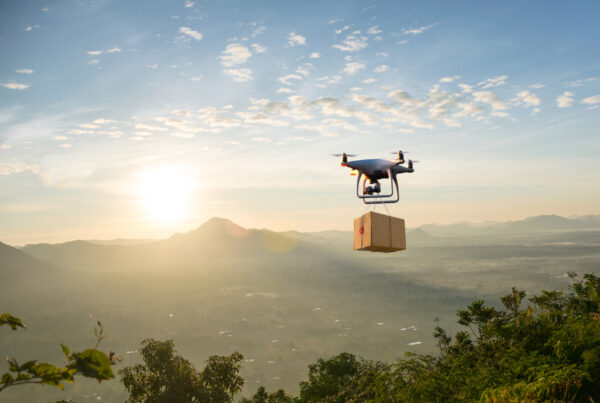
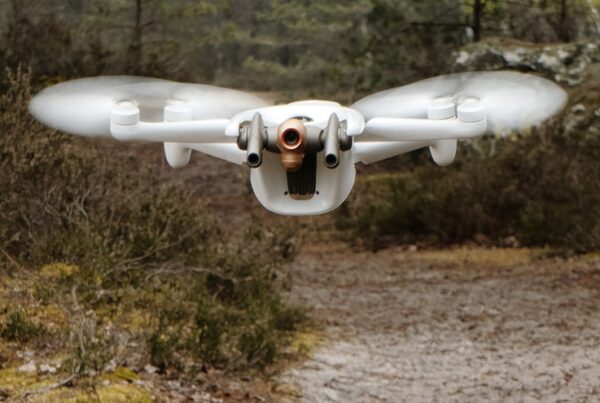
Real-time kinematic (RTK) technology has emerged as a game-changer for drone mapping. Unlike consumer-grade GPS units, RTK drones are equipped with high-precision GPS receivers that enable real-time correction of satellite positioning signals. Post-processing kinematic (PPK) software takes a different approach— instead of providing real-time corrections, PPK relies on post-processing the data collected by the drone after the flight. This post-processing involves comparing the GPS data with data from a ground reference station, resulting in highly accurate positioning information.
RTK in Commercial Applications:
- Precision Mapping and Surveying:
Usage: RTK technology is extensively employed in mapping and surveying applications where high precision is paramount. This includes topographic surveys for construction projects, land development, and urban planning.
Why: The real-time correction capability of RTK ensures that mapping data is accurate to the centimeter level. This level of precision is crucial in construction and urban planning to avoid errors in measurements and ensure proper alignment with design specifications.
- Agricultural Monitoring:
Usage: In precision agriculture, RTK-enabled drones are used for crop monitoring, yield prediction, and variable rate applications. This involves assessing the health of crops and optimizing resource usage based on real-time data.
Why: RTK provides farmers with accurate spatial information about their fields, enabling precise application of fertilizers, pesticides, and water. This not only improves crop yield but also contributes to sustainable farming practices.
- Emergency Response and Disaster Management:
Usage: RTK-equipped drones play a crucial role in emergency response scenarios, such as natural disasters or accidents. They are used for rapid mapping, damage assessment, and search and rescue operations.
Why: Real-time accuracy is essential in emergency situations where quick decision-making is crucial. RTK drones provide up-to-the-minute data, aiding responders in understanding the situation, assessing damage, and planning effective interventions.
- Infrastructure Inspection:
Usage: RTK is employed in inspecting critical infrastructure like bridges, power lines, and pipelines. Drones equipped with RTK technology can capture detailed data for assessing structural integrity and identifying potential issues.
Why: Real-time precision ensures that any deviations or structural problems are immediately identified, allowing for timely maintenance and preventing potential disasters.
PPK in Commercial Applications:
- High-Precision Surveying:
Usage: PPK technology is commonly used in high-precision surveying applications where meticulous accuracy is required. This includes geodetic surveys, boundary mapping, and large-scale infrastructure projects.
Why: PPK allows for post-processing of data, enabling correction with ground reference stations. This ensures that survey results are highly accurate, making it suitable for projects that demand precision but may not require real-time data.
- Topographical Mapping in Challenging Terrains:
Usage: PPK is well-suited for topographical mapping, especially in areas with challenging terrain. This includes mountainous regions, dense forests, and areas with limited accessibility.
Why: Post-processing allows for thorough analysis and correction of data, compensating for challenges posed by difficult terrains. This makes PPK ideal for projects that require detailed topographical information in less accessible areas.
- Archaeological and Cultural Heritage Documentation:
Usage: PPK technology is employed in documenting archaeological sites and cultural heritage. Drones equipped with PPK can capture precise 3D models of historical structures and artifacts.
Why: The high accuracy provided by PPK ensures that the digital reconstructions and documentation of historical sites are faithful to the actual structures. This is crucial for preservation and research purposes.
- Pipeline and Utility Monitoring:
Usage: PPK is used in monitoring and inspecting pipelines, utilities, and linear infrastructure. Drones equipped with PPK can provide accurate spatial information for maintenance and planning.
Why: The ability to achieve high accuracy through post-processing is beneficial in infrastructure projects where precise spatial data is essential for planning maintenance activities and ensuring the integrity of pipelines and utilities.
Choosing the Right One for Your Needs
The choice between RTK and PPK in commercial drone applications depends on the specific requirements of the mission. For scenarios where real-time precision is imperative, such as construction site monitoring or emergency response, RTK drones emerge as the go-to solution. Their ability to provide immediate, centimeter-level accuracy positions them as indispensable tools in time-sensitive projects.
On the other hand, when precision takes precedence over time constraints, PPK technology steps into the spotlight. Industries like surveying and topographic mapping, where meticulous accuracy is the primary goal, find PPK to be a reliable ally. The post-processing capabilities of PPK ensure that every data point is scrutinized and corrected, leading to maximum precision.
Challenges
The benefit of RTK lies in its ability to provide real-time, centimeter-level positioning accuracy, RTK drones come with their set of challenges. The need for a reliable and continuous communication link with the base station creates limitations on the operational range. Additionally, factors like signal obstruction and interference can impact the real-time correction process, requiring careful consideration of the operational environment. In urban environments or areas with dense foliage, satellite signals can be obstructed, leading to accuracy degradation.
PPK offers operational flexibility because it’s not constrained by the need for a continuous communication link during the flight. However, the post-processing nature of PPK means that the results are not immediately available. This may be a limitation in applications where real-time decision-making is essential. Additionally, the complexity of post-processing can be a hurdle for those not well-versed in the intricacies of the technology.
Both technologies can be affected by atmospheric conditions and changes in weather, impacting the reliability of the positioning information.
In conclusion, the RTK vs. PPK debate in commercial applications is not a matter of one technology being superior to the other. Instead, it’s about aligning the choice with the specific needs of the mission at hand. As technology continues to advance, the intersection of real-time precision and post-processing accuracy will likely pave the way for even more sophisticated solutions, further elevating the capabilities of commercial drones in diverse industries.