

In the law enforcement and public safety industries, drones have long since stopped being a novelty item. Instead, at least 347 state and local police agencies are now using drones on a routine basis, for everything from monitoring crowds to providing aerial mapping. As drones continue to advance, their impacts in these industries continues to expand, as well.
Drones in the Police Force
Police stations are always adding new equipment to their forces, and drones are no exception. One of the first agencies to adopt drone technology was the Los Angeles County Sheriff’s Department, or LASD. In 2006, the LASD introduced a fixed-wing drone to test internally. Since then, drones have expanded into virtually every aspect of public safety. The expansion has been especially prominent since the introduction of affordable, easy-to-access, easy-to-use consumer drones, such as the DJI Phantom.
Today, city and county police and sheriff’s departments are using drones for a variety of applications, including the following:
- Using thermal imaging and mapping to recover people lost people in the wilderness
- Surveying public beaches to identify hazards, such as sharks, in the water, and to warn swimmers before anyone is injured
- To drop flotation and self-rescue devices to stranded swimmers, boaters, or water sports participants
- To monitor damage, conditions, and closures during major disasters
- To provide aerial reconnaissance for wildland fires, and to map the directional spread of flames. Drones are also used to map fire spread and direct elite firefighter efforts
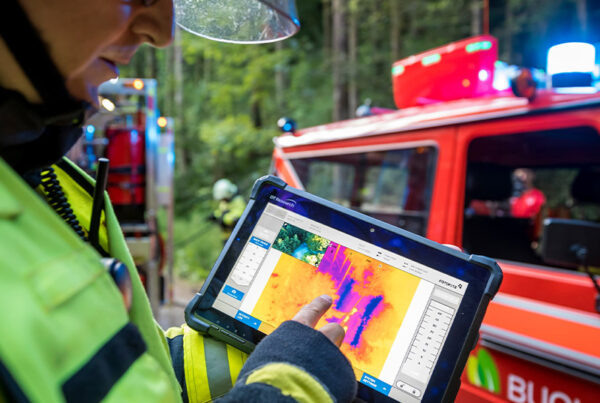
- To identify dangerous situations at structure fires with thermal imaging cameras
- To identify hazardous materials with a remote hazmat sensor
- To identify and contain otherwise invisible plumes or releases of toxic or hazmat substances
- To provide overwatch during dangerous law enforcement tactical efforts
- To secure buildings and clear areas of bad actors before a SWAT attack, or to monitor hostage situations and promote resolution
- To reveal and monitor damage to public infrastructure, such as dams and roadways
- To help monitor volcanic fissures, lava flow, damage to houses, and evacuation areas during natural disasters
- To secure prisons and correctional facilities
- To act as first responders, arriving at a disaster scene before patrol cars and providing immediate information to dispatch & officers
Real-Life Application of Done Technology
Curious how real-world police departments are using drones to support their operations? Consider the Moore County NC Sheriff’s Office, which used drone technology to rescue an 11-year-old girl who wandered into the woods. Team lieutenants brought an agency drone to the scene and flew it over the wooded area. Using the drone’s thermal imaging system, the team was able to identify the sleeping shape of the girl, where she had fallen into exhaustion in a thick, heavily overgrown area that had already been searched by ground teams.
According to Government-Fleet.com, Moore County Sheriff Neil Godfrey told local media that it would have taken 45 minutes or more to bring a helicopter on scene. The drone gave the Moore County SO an air asset that it could deploy quickly and prevent a possible tragedy.
The Future of Drones in Public Safety
Today, public safety is the main industry that has adapted drones. Here at DroneNerds, we currently supply some of the largest agencies in Florida with the hardware, cameras and software they need to overhaul their drone programs. As drone technology continues to expand in the public safety sector, DroneNerds will continue to be there with everything agencies need to succeed. After all, we don’t just offer drones, we’re also the go-to source for cutting-edge technology, advanced sensors, and a host of other specialized accessories.
Contact us today to learn more.


More and more PDs and SOs will be using drones. They are excellent tools.